** Free Web Page Translators in Multiple Languages**
Abstract
Our youth of today look at the educational system and ask, "Why?" They look at the values of their parents and say, "That's not for me!" They laugh at the political machinery, see how environmental and social concerns are few, and say, "Nothing is working." They live with hopelessness in a love-starved world and feel, "What's the use?" So begins the life of abuse in all its ugly forms. Warehousing of youths within the social systems only continues this disempowerment. They take it out on themselves without knowing what they are doing or why, causing social issues of near epidemic proportions in our burgeoning cities and an overload for our courts, educational and social service systems. Can we find collective answers and implement solutions? We believe so.
Visionary insights and perspectives lead to paradigm changes in society. Currently, the situation regarding at-risk youth is cumbersome and oblique in regards to understanding the ‘big picture’ and the solutions necessary to empower change in our youth. As a society, we are failing to address critical needs of our youth. Recidivism within the youth correctional and social service programs, evidenced by the high concern of State officials across the nation, needs our collective attention now. We need a program that synergizes available resources and rallies the public spirit toward a new approach to empowering change within the disenfranchised youth caught in the cycles of rebellion and rejection.
Experience and research have shown that these three components- charter school, residential treatment center, and community technology center- can indeed work as one, which can profoundly affect youth in positive directions. Spectrum Academy, as a learning organization, uses a holistic systems thinking approach toward education. The programs meet the emotional and intellectual needs of the youth, which allows the person to grow and the student to learn the value of their education. The need for implementation of a better approach is obvious to those within the system. This business plan details a high-level framework and action plan that takes initiative. Spectrum Academy is ingenious, innovative, and timely for our youth.
Namaste,
Bruce ‘Zen’ Benefiel, MBA, MAOM
Robin J. Engel, BAEd, MAOM
Table of Contents
Sales Literature (in development)
Sourcing and Distribution Channels
Community Technology Center/e-Curriculum Delivery
Strategy Implementation Summary
Governing Body – Temporary Board
Key Assumptions Used in Forecasting
Source and Application of Funds (recommend further research)
Risk Analysis (recommend further research)
Balanced Scorecard for Educational Business Unit
CTC Cash Flow Projection Year 1
CTC Cash Flow Projection Year 2
CTC Cash Flow Projection – Year 3
CTC Cash Flow Projection- Year 4
Expanded project- Genesis II Multiverse Communities

Business Plan
Executive Summary
Summary of Situational Analysis
Only 45% of Arizona youths detained by police last year were enrolled in school. (Juvenile Processed, 2002) “In 1990, minority youth were likely to have less favorable outcomes than Anglo youth that commit comparable offenses. In 2000, using reported data and a comprehensive qualitative process - where key stakeholders were interviewed and focus group sessions were held with individuals actively involved in the juvenile justice system - there is substantive agreement that minority youth are still over-represented when compared to their Anglo counterparts for comparable offenses.” (Commission, 2002)
Peer-community facilitators, as change agents, are rare in the development of alternative solutions to this growing problem: disenfranchised youth. Spectrum Academy is a potent answer to the current crisis facing our educational and juvenile systems today. It is a combination of a youth residential treatment center (RTC), charter school, and community technology center (CTC). This concept encompasses the value of education as emotional rips repair, because an emotionally unavailable youth cannot learn effectively. The community technology center promotes positive social interaction while facilitating the delivery of inexpensive e-curriculum to its patrons and to the vast array of charter schools that are struggling with the high costs of state-of-the-art education.
It seems our very survival, according to the analysis of socio-economic systems, depends on consumerism, cultural genocide, and environmental destruction for the sake of fossil fuels, fast foods, and corporate profits. This behavior affects our children immensely as they see no ‘common sense’ in our survival living styles. The old formulas simply do not work anymore; students are dull and listless in the classrooms, yet need healthy rites of passage. Emotionally and intellectually disenfranchised youth internalize their anger and act out in unprecedented violence toward self and others. Traditional education has not addressed the growing emotional and intellectual needs of our children; the connectedness of mind, body, and spirit. Currently, the situation regarding at-risk youth is cumbersome and oblique in regards to understanding the ‘big picture’ and the solutions necessary to empower our youth. A new myth is in process of creation and you can participate right now, today. Are you ready?
Opportunity Summary
Ted and Nancy Faust Sizer wrote in their book, The Students are Watching, “A student’s hope and sense of agency is often dependent on her sense that there is something that she can do which is valued by others”. Spectrum Academy’s unique program offers students structure to find success in new experiences and provide valuable work opportunities, reflecting increased personal value and self-esteem. Nurturing the individual is an important part of this plan. The disciplined structure provided some latitude and offered students the guidance to learn how to make positive choices in their lives.
Vision: Spectrum Academy, a proactive and progressive holistic educational environment, identifies and addresses the changing developmental and personal needs of challenged youths, empowering them to prepare for their journey toward successful community awareness and participation.
Holistic education is concerned with the growth of every person's intellectual, emotional, social, physical, artistic, creative and spiritual potentials. We are unique as a leader in the research, design, and implementation of holistic education using state-of-the-art technologies. Our collaborative alliances and partnerships with industry leaders bridge 21st Century learners with 21st Century technology and our emerging global culture.
Mission: Provide an alternative state-of-the-art holistic educational and living environment for youth 14 - 21 using peer-community development protocols, supportive of the community socio-economic structure, resulting in healthy and productive young adults who contribute to society.
We believe our first responsibility is to prepare the students to meet the challenges of the rapidly changing world around them. A holistic strategy in a peer-based community atmosphere facilitates students to perceive and understand the various contexts that shape and give meaning to life. Introducing students to a holistic view of the planet, life on Earth, the emerging world community, and the students’ interdependence demonstrates best practices of systems thinking. The environment and staff will nurture the development of emotional and multiple intelligences empowering each student’s personal growth. Engaging systems thinking requires student involvement in the research and design of their educational process, which creates ownership of learning. A collaborative approach toward problem solving develops critical interpersonal skills. Emerging technologies and their integration into our curriculum provide the students with real-time real-world experiences that prepare them for entering post-secondary life.
Imagine a fully integrated approach to inspiring and challenging our youth of today... aware of our problems and quickly focusing on creative solutions that empower balanced choice. Empowered adults now can empower our youth. The human race has entered a new era, an evolution in educational and social methodologies. Visionary perspectives lead to paradigm changes in society. Our world faces critical situations in developing our future society. Humanity is ripe for change. Primary areas of concern are commerce, education, administration of resources, and intense exploration into the depths of what keeps us afraid, angry, ignorant and immobile.
Key
Recommendations
Spectrum Academy is a potential answer to the current crisis. It is a combination of a youth residential treatment center (RTC), charter school, and community technology center (CTC). Experience and research have shown that these three areas can indeed work as one, which is what we intend to demonstrate through the creation of such an environment. We call this environment Spectrum Academy. The charter school is our first order of business.
A healthy life includes several areas of mastery, which most adults still have difficulty achieving in their daily living and working experience. Youth today have an even more demanding scenario as the world around them is changing rapidly. These basic areas of focus include Work; Intellect; Life Planning; Fulfillment; Recreation; Motivations; Health; and Relationships. Be The Dream, a 501 (c) (3) educational corporation, has determined that the synergy of the residential treatment center, charter school, and community technology center is what will determine a successful endeavor as the process develops through best practices of pedagogy and management philosophy.
Key Financial Start-up Assumptions
Charter School
Start up - $300,000
Annual Budget – $1,200,000
Community Technology Center – e-Curriculum Data Center
Data Center start up – $430,000
Residential Treatment Center
Start up $71,000
20-bed annual budget $1,854,000
Land Purchase - Construction Costs $50,000,000
Forecasted Operational and Financial Results
 150 students- charter school is financially operational
beginning the third year.
150 students- charter school is financially operational
beginning the third year.
Forecasts show the CTC/Data Center business unit reaches
break-even in 6th month of the second year.
Forecasts for the residential treatment center are being
compiled.
Invitation
Imagine a fully integrated approach to inspiring and challenging our youth of today... aware of our problems and quickly focusing on creative solutions. The human race has entered a new era, a revolution in educational methodologies. We are unveiling the embryo of an integrated master plan that could solve our educational and behavioral difficulties- unifying youth and adults while building individual and community respect.
We need solutions to bridge concepts and creators, chaotic experiences with order and structure. Chaos is only the beginning of the process of establishing natural order. Conflict, used wisely, evolves into harmony. Can we acknowledge that we have been going in the wrong direction? Better yet, can we accept that we have done the best we could with limited information and resources and now have better information and greater resources to affect positive change? Spectrum Academy offers solutions today that will change the patterns of problems of today by offering habilitating healthy habits for tomorrow. Please join us in this endeavor to empower our youth, now and for future generations.
Situational Analysis
In our world today, children suffer. Across Arizona and America, the suffering continues and the complexity of the issues rise exponentially as the global village expands. Educational systems, family environments and welfare agencies, no longer nurture the creative spark in our children; the love and care every child deserves and needs. Children who overcame the myriad of abusive scenarios are teaching others, both young and old, of the necessity to love and be loved. Many youth are caught in a frustrating correctional system that is challenged to reduce recidivism. Repairing emotional rips and tears in the family unit, if there is one, challenges yet another overburdened system. The survivors are doing a fantastic job in nurturing those they can, sharing volumes of experience, harvesting their past and showing the rest of us the path to a new approach, which shares accountability and responsibility. A nurturing environment that provides emotional and intellectual freedom to respond and grow personally and socially demonstrates a caregiver community’s love.
Anyone who works with at-risk youth understands that much more can be done toward addressing his or her needs. In the U.S. alone, many are warehoused in group homes with little or no opportunity to develop the necessary life skills to survive and thrive in today's world. Job markets are shifting faster than academic programs can keep up. Rather than create environments that nurture multiple and emotional intelligences, we drug our youth into submission and wonder why they choose to self-medicate and defy the 'system' that holds them captive. Adaptive systems and 'wrap-around' models in social services still only address the problems and symptoms of this decay in moral servitude. Peer-community facilitators, as change agents, are few and far between in the development of alternative solutions to this growing problem. Developing a model community that demonstrates integrated solutions seems to be in order.
Innovative Community and Student Support
Spectrum Academy involves recurring themes throughout successful educational and youth programs, which are intensive family involvement; peer mentorship; intensive psychological treatment that includes all aspects of their lives; the use of animals as metaphor and therapy; a return to nature; stringent structure; individualized programs; and the instruction of new coping and living strategies. Habilitation of our youth is a priority at Spectrum Academy. Developing a peer-based community that reduces recidivism through effective education of conflict resolution applied to individual and group environments is one of our primary goals.
|
|
Strategic Goal #1- Internal
|
|
||
|
|
Key Components |
Objectives |
|
|
|
|
1. Student Achievement
|
|
|
|
|
|
2. Student Enrollment
|
|
|
|
|
|
3. Faculty & Staff Development
|
|
|
|
|
|
4. Parent Involvement
|
|
|
|
|
|
5. Internal Communication
|
|
|
|
|
Strategic
Goal #2- External |
||||
|
Key Components |
Objectives |
|||
|
6. Leadership Development
|
|
|||
|
7. Funding
|
|
|||
|
8. Charter Renewal
|
|
|||
|
9. Partnerships
|
|
|||
|
10. Facility
|
o Lease of a new site o Purchase of a new site
|
|||
|
11. External Communication
|
|
|||
Function
The function of holistic education within the community exemplifies the systems approach in business, education, and community. The cohesive and comprehensive approach integrates the current and future needs of our developing local and global communities. It is the total immersion of the student in their environment, utilizing best practices of educational processes, and connecting real-world exploration that prepares students with critical thinking, problem-solving, and entrepreneurial skills to meet life’s callings. Ultimately we all seek some joy of living; enjoyment of life. Mihaly Csikszentmihalyi’s research identifies some interesting details that not only acknowledge the obvious; they reveal potential structure for creating environments that illicit personal and professional growth, which is so necessary for the future of students and their success in life.
“As our studies have suggested, the phenomenology of enjoyment has eight major components. When people reflect on how it feels when their experience is most positive, they mention at least one, and often all of the following. First, the experience usually occurs when we confront tasks we have a chance of completing. Second, we must be able to concentrate on what we are doing. Third and fourth, the concentration is usually possible because the task undertaken has clear goals and provides immediate feedback. Fifth, one acts with a deep but effortless involvement that removes from awareness the worries and frustrations of everyday life. Sixth, enjoyable experiences allow people to exercise a sense of control over their actions. Seventh, concern for the self disappears, yet paradoxically the sense of self emerges stronger after the flow experience is over. Finally, the sense of the duration of time is altered; hours pass by in minutes, and minutes can stretch out to seem like hours. The combination of all these elements causes a sense of deep enjoyment that is so rewarding people feel that expending a great deal of energy is worthwhile simply to be able to feel it.” (Flow, 1990)
Given these factors and the capacity to meet them in an educational environment, we feel that not only will the students have the opportunity to experience success academically; the community, of which the school is a part, will experience success in real-world models as they develop their future vision, engage their peers, and extend their influence into society. The inclusion of a percentage of disenfranchised youth in the school population effectively cleans the fish tank instead of just wiping off the fish. The results are empowered youth who can make positive choices and provide leadership for their peers.
Holistic education means that the organization itself has to be aware and functional within the realms of mind, body, and spirit. On a pragmatic level, this means that we consider the ‘total system’ of a human being in process of development. Gardner found that there are multiple intelligences at work in the learning system of a student. Goleman brought emotional intelligences to our awareness. Others, like Steiner and Montessori, have attempted to address these intelligences in their own ways, whether acknowledging them outright or just by knowing there is a ‘better’ way to prepare youth for the journey of life. Csikszentmihalyi, Covey, Drucker, DeBono, Peters, and Senge are all pointing toward personal and organizational transformation through understanding the connectedness of people and process. Systems-thinking is a core competency of that kind of organization. The ‘systems’ approach here is to identify and nurture the natural skill sets of the individual in order for them to find their natural order and place within the collective, evidencing and exampling a holistic lifestyle that affects positive change.
Traditional structure found in both business and education is hedging the idea of initiative and innovation through understanding the need for collaborative alliances – cooperation instead of competition. Edward DeBono clearly addresses this concept below:
“At any moment our thinking is shaped by a number of factors. Sometimes we are aware of these factors and sometimes they are so much in the background that they exert their powerful influence in a hidden way. We can challenge these shaping factors just as we challenge existing methods, concepts, or ideas. But in this case we are not challenging something that already exists. We are challenging the factors and pressures that lead us to think in a certain way.” (Serious Creativity, 1992)
Leading innovative peer-community student programs and services:
Problem-solving and reasoning skills: Children who think
that there are only two ways to solve problems--fight or give-up--are more
likely to become either perpetrators or victims of violence. Children's
ability to reason well can give them a wider variety of options than just
fighting or running. Children who are more proficient at generating and
evaluating options in academic and social settings are less likely to choose
violent ways of solving conflicts and promote the same behavior tendencies in
others.
Social capacities: These skills, attitudes, and
dispositions include development of empathy, effective communication, humor,
and attachment to positive, non-violent individuals or groups. Understanding
another person's point of view and having concern for other persons can help
students generate a wider variety of options--some of which may be mutually
acceptable. Students must be able both to listen with understanding and to be
understood. The ability to laugh and create moments where others, too, feel
more light-hearted can often become one of the most successful options to
reducing violent responses. Humor can also enable someone not to immediately
take things too personally. The ability to be a friend and have friends can
create a stronger desire to find non-violent ways of solving conflicts.
A productive sense of purpose, independence, and power:
Children who are more likely to turn to violence have no hope in the future.
Conversely, children who believe they can control their lives and want to
direct their lives in positive and productive ways are more likely to seek
non-violent means to resolve conflict.
Peer mediation programs:
Teaches students to view conflict as a natural part of life
Teaches students to solve their own problems
Improves communication, critical thinking and negotiation skills
Reduces the time teachers and administrators spend on discipline
Reduces the number of detentions and suspensions
Promotes intercultural understanding
Fosters a climate within the school that is conducive to
learning
Initial assessments of students/clients in:
Aptitude and Ability
Multiple Intelligences
Emotional Intelligences
Learning Styles
Holistic Understanding
Special Needs
Systems Thinking Awareness
Company Background
Spectrum Academy is an educational branch of Be The Dream, a non-profit 501 (c) (3) registered educational and philanthropic corporation in the State of Arizona. The Co-Directors of Be The Dream reside in the Town of Gilbert. Spectrum Academy will include the staff and teachers as owners and stakeholders within the first year of operation. Collective ownership is yet another facet of the holistic system approach.
Start-up Plan (US Charter Schools Model)
First Level WBS Network Diagram
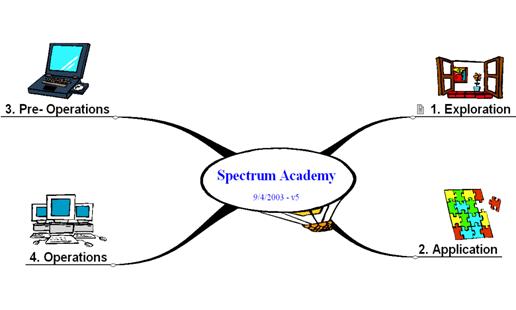
Second
and Third Level WBS Network Diagrams





Project Mgr. Ed. Mgr. Bus. Mgr. Com. Mgr. Asst. Status
Deliverables
Core Group/Experts R C C/S C C I
Comprehensive Plan C/S R C C C I
Charter Draft R C/S C C C I
Charter Application R C/S C C C I
Letters of Support R C C C/S I I
Operations Plan C/S C R C C I
Operating Agreements C/S C R C I D
Formal Organization R C C C I I
Enrolled Students I R C C C NS
School Staff C/S R C C C I
Instructional Program C/S R C C C I
Support Services S I R I I D
Building/Site S C C R I D
Student Performance Data S R I I C NS
Stakeholder legend: I-Informed S-Signs-off C-contributor R-responsible
One Responsible and one Sign-off per deliverable
Legend: NS-Not Started C-Completed I-In progress D-Deferred O-Overdue
Initial development of Spectrum Academy will be in the Gilbert/Chandler, Arizona area. A specific location has not been determined, although options are being considered. The ideal location would have some existing structures for initial classrooms and administrative activity with suitable acreage (150-200) for development and expansion.
Key Products and Services
Qualities and Dimensions of Effective Youth Education
Effective youth education responds to the real lives, needs and interests of youth.
Youth feel like they matter.
Holistic education is innovative and dynamic.
There is not one model – in this environment there is a
relational pattern of knowing youth; innovating and changing in order to be
responsive.
Hospitality and relationship building are foundational to effective youth education.
Young people are welcomed and accepted.
Extending personal invitations, providing warm groups is
intentional and ongoing.
Web of relationships: youth with youth, youth with adults,
business community with youth, youth in their families.
Effective youth education has a variety of ways for youth to be involved.
Boundaries between programs are permeable.
Holistic education is multifaceted.
There are variety of levels of participation among youth and
their families.
In effective education, youth are active in making positive changes happen (youth are not passive receivers of learning.)
Youth have ownership of their education efforts.
Youth share leadership in programs and visioning.
Youth relate and share their success with their peers.
Leading programs help youth grow in their own empowerment and
self-esteem.
SPECIFIC PROGRAMS / COMPONENTS
Holistic Education Formation
Education with adolescents most often begins with real life issues and
connects learning to life. Learning formation is at the heart of youth
education. To be effective and engaging with youth, learning formation has
these qualities:
Facilitated by open-minded, authentic, passion-filled adults
Engages youths’ energies toward inclusion rather than exclusion
Includes community building, peer and social
Includes peer sharing, empowerment and leadership
Includes animal care and gardening/landscaping
Teaches about personal identity and relation to the world
Seizes teachable moments as the most precious commodity
Is experiential, active and innovative in the rapid-change
environments
Doesn’t feel like school – doesn’t lecture or have too much
focus on textbooks.
Community Service
The experience of service helps youth grow in compassion and understanding. An
effective method of engaging youth in community service is educational
reflection – connecting acts of service to learning, peer-community social
teachings and everyday life. These experiences:
Change their perspective
Broaden their awareness
Create empathy
Help youth feel valuable
Make life real – hands on and heart-centered
Form community
Leadership
Youth have a different way of expressing understanding within daily living –
it is more sensual. Youth’s expression of connecting school-to-living in daily
life needs incorporation into the celebration of success. Music and wholesome
activities are important for youth to engage in their experience. The
involvement of youth in community service brings tremendous value to the
community – providing energy, skill and powerful presence. For the young
people it builds confidence, self-esteem, and helps them develop life goals.
Extended Trips
Trips, camps, conferences and regional events are important because they:
Help youth feel pride and enthusiasm in their transformation
Build community among youth
Build community between youth and adults
Create opportunities for leadership
Amaze young people by connecting them with large numbers of
other youths in the community.
Retreats
Youth retreats have a unique ability to touch the hearts of young people,
build communities of service, help youth to grow closer to their own inner
fortitude and draw youth back into active involvement in life. Retreats change
the lives of young people. Studies have shown:
Youth mentioned the life changing impact.
Adult leaders frequently mentioned some aspect of peer
community/leadership.
Staff recognize profound positive changes in youth.
Educational Assessments
Linking assessment to instruction - embedding it in the process of learning - is critical to full implementation of new science standards. To allow students to construct learning in the classroom through authentic experiences, assessment must be:
Open-ended, allowing for discussion
and revision of new understanding.
Tolerant of divergent thinking and
promote the notion of no "one right answer."
Presented in alternative modes, not
just written responses to limiting questions.
Designed to foster analysis,
comparison, generalization, prediction, and modification.
Capable of promoting collaboration
and team effort in demonstration of competence.
Ongoing and cumulative, showing
growth over time. (NCREL, 2003)
Design of the Assessment Process
Student, faculty, and administrative
goals and objectives to improve student academic achievement
Statements about how much
responsibility the faculty have for the design and implementation of the
assessment plan
Role of faculty development and
training in assessment
How to utilize faculty expertise in
the assessment process
Program reviews for academic
departments
How the school can use students,
faculty, and administrators in its multiple measures
Role of administrators in the areas
of budgeting, resource allocation, and time management for the assessment plan
“A spiritualized education would seek to open the mind, warm the heart and awaken the spirit of each student. It would provide opportunities for students to be creative, contemplative, and imaginative. It would allow time to tell old and new stories of heroes, ideals and transformation. It would encourage students to go deep, into themselves, into nature, and into human affairs. It would value service to others and the planet.” (Spirituality, April 14, 2003)
Research has determined that there are few, if any, that apply the complete concept of Spectrum Academy. Several residential programs include elements of holistic education, peer-mediation/community, and/or community technology centers. Spectrum Academy is a Vision of Value for empowering disenfranchised youth caught in the throws of insolence and maturation. A full comparison on Spectrum Academy’s competition would take substantially more research and recommended as part of further development.
Sales Literature (in development)
Marketing is through presentations and web-based activity with few exceptions. Promotional materials are not complete at this time. Points addressed in marketing campaign include:
Active student, parent, community and teacher participation in
debate and decision-making are essential to strengthening public education.
Society reinforces public education's importance in a democracy
by publicly governing schools, in addition to publicly financing
them. Rather than diminishing parents' responsibility for their children, this
underlines the collective responsibility for everyone's children.
Improving the quality of, and access to, education must drive
the agenda for educational reform, rather than fiscal restraint or ideological
conviction.
The public education system currently makes available, and is
committed to continuing to offer, a variety of program options to meet the
diverse needs of all students.
A publicly funded, democratically governed system of education
with a mandate to provide quality education for all children should not
be undermined by charter schools.
True choice in education must enhance educational equity, making
pedagogically-sound choices equally available to all.
Sourcing and Distribution Channels
21st Century learners need 21st Century technology at their fingertips, including:
State-of-the-art computers and LAN
Updateable e-curriculum supplemented learning
Multiple intelligence learning centers
Emotional intelligence development
Multi-media studio – computer-based
Ergonomic classrooms w/special needs inclusion
Core subject state-of-the-art lab materials
State-of-the-art machinery for vocational programs
Supply Chain Management
The supply chain management philosophy applied to the school environment would call for the integration of customer and company, student and school, parent/partner and community. Practical applications of research bring the cross-functional teams together to share information, materials, and resources that empower the school’s compliance with its mission. The vision of the founders includes the incorporation of supply chain management applied to creating collaborative alliances, which also includes the research and development of resources. The Advisory Council and Board of Directors are utilized for contacts and resources to help establish relationships that can benefit from research provided by the school through its students and staff.

Community Technology Center/e-Curriculum Delivery
“Long distance learning has taken on a important role in developing countries like Brazil, where the vast territory and large population requires the use of powerful tools capable of offering quality education courses, from entry level post-secondary studies to masters and doctor degrees. The rising demand for such education courses has provoked the need for developing collaborative alliances between academic institutions and clients.” (Azevedo, et al, 1999)
The delivery of curriculum through electronic means is a growing trend in America. Developing a Community Technology Center (CTC), with data center capacity, to compile and deliver e-curriculum serves not only the community of residence; it also allows businesses, home-schoolers, and public and private schools across the nation low cost access to state-of-the-art curriculum. This feature can fund the RTC in three years. This also fits with the 21st Century Technology Educational Centers program currently offered by the U.S. Department of Education.
Future Development
Contracted curriculum packages (bundled or stand-alone) will offer educational programs at greatly reduced costs, increasing access to low-income areas. This increases opportunity for teacher-developed curricula and making it available to large numbers and remunerate the creators in the process. Community Technology Centers, developed as partnerships with schools, provide additional capacity for adult education programs for acquiring a GED or college credits toward degree programs. Community-based educational programs empower community leaders and members to effectively develop and manage community affairs. Access to social services electronic programs increases quality of life for low-income community members.
CTC Opportunities
Charter schools that choose to work together, sharing site licenses, can reduce curriculum expenses while increasing teacher effectiveness, which means more time with the students and easier lesson planning. Web hosting services, along with e-mail, provide schools greater exposure with less cost. Internet content filters installed on-site keeps clean content delivery for students and teachers. Non-Profit Organizations benefit through reduced costs, greater accessibility of Internet or Web-related services, while building capacity in the development of the network of organizations and service to the community. Service Organizations can offer assistance, information, and programs while establishing growth in their community network. Discussions, forums, web-based workshops are made available with ease of data management. (see Appendix – Community Technology Center Cash Flow Projection)
Youth Residential Treatment Facility (RTC)
At-risk students are often wards of the court or in behavioral/correctional programs. Additional funding sources are available through RTC development and utilized in the overall educational programs offered by Spectrum Academy. A peer-based community wrap-around model, including support systems of family, friends, teachers, therapists, probation officers, etc. is currently a goal established with the partnership of the Arizona Juvenile Corrections Department and Value Options service provider. Recidivism decreases dramatically through peer-based programs that empower leadership development. (see Appendix – RTC Start-up Costs)
Market Analysis
The Town of Gilbert, Arizona is the initial site development location. Gilbert is the eighth largest city in Arizona with a 10-year 265% increase in population. The Per Capita income was $24,792 in 2000 with a near 80% Caucasian population. Service area will include Maricopa County as program expands.

Population Stats as of 2000
|
Town of Gilbert Comparison |
Gilbert |
|||
|
Pop. 1990 (Rev.) |
30,003 |
988,983 |
417,139 |
45,857 |
Income Stats as of 2000
|
Town of Gilbert Comparison |
Gilbert |
|||||||
|
|
Count |
% |
Count |
% |
Count |
% |
Count |
% |
|
Households 2000 |
35,512 |
|
466,114 |
|
192,884 |
|
19,355 |
|
Ethnicity Stats as of 2000
|
Town of Gilbert Comparison |
Other Metropolitan Areas |
|||||||
|
|
Gilbert |
|||||||
|
|
Count |
% |
Count |
% |
Count |
% |
Count |
% |
|
Pop. 2000 |
109,697 |
|
1,321,045 |
|
486,699 |
|
52,894 |
|
Sources: US Census Bureau and Synergos Technologies, Inc.
Market Needs
Holistic education
Special needs programs
College prep
Life skills
Technology-driven
Peer-community
ESL inclusion
Homeschooling
Educational Trends
There are 116,910 public and private schools with K-12 students in the United States alone, of which 89,508 are public. Virtually every public school is now connected to the Internet. In the US alone, there are over 52 million K-12 school students and 4.2 million K-12 teachers. USD 351 billion was expended on K-12 education in 1999 with an additional USD 232 billion spent on post secondary education, not including vocational, specialty and professional development training. (Source: National Center for Education Statistics) It is estimated that schools write 25 million purchase orders in a year at a cost of between USD 100 and USD 150 above the actual cost of the product for each requisition. (Source: Lamar Alexander, CEO of Simplexis.com, February 1, 2000).
Ten Educational Trends Shaping School Planning and Design
The Lines of Prescribed Attendance Areas Will Blur
Schools Will Be Smaller and More Neighborhood Oriented
There Will Be Fewer Students Per Class
Technology Will Dominate Instructional Delivery
The Typical Spaces Thought to Constitute a School May Change
Students and Teachers Will Be Organized Differently
Students Will Spend More Time in School
Instructional Materials Will Evolve
Grade Configurations Will Change
Schools Will Disappear Before the End of the 21st Century (Or
Will They?)
(Kenneth, 2002)
According to the National Home Education Research Institute, there were and estimated 1,700,000 to 2,100,000 children (grades K-12) home educated during 2002-2003 in the United States. In 2000-2001 the number was about 1.5 million to 1.9 million, demonstrating a continued growth in home educated youths. Now the concept of holistic education is reaching the halls of academia.
Holistic Education...
is concerned with the growth of every person's intellectual,
emotional, social, physical, artistic, creative and spiritual potentials. It
actively engages students in the teaching/learning process and encourages
personal and collective responsibility.
is a quest for understanding and meaning. Its aim is to nurture
healthy, whole, curious persons who can learn whatever they need to know in
any new context. By introducing students to a holistic view of the planet,
life on Earth, and the emerging world community, holistic strategies enable
students to perceive and understand the various contexts, which shape and give
meaning to life.
recognizes the innate potential of EVERY student for
intelligent, creative, systemic thinking. This includes so-called
"students-at-risk", most of whom have severe difficulties learning within a
mechanistic reductionistic paradigm, which emphasizes linear, sequential
processes.
recognizes that all knowledge is created within a cultural
context and that the "facts" are seldom more than shared points of view. It
encourages the transfer of learning across separate academic disciplines.
Holistic education encourages learners to critically approach the cultural,
moral and political contexts of their lives.
values spiritual literacy (in a non-sectarian sense).
Spirituality is a state of connectedness to all life, honoring diversity in
unity. It is an experience of being, belonging and caring. It is sensitivity
and compassion, joy and hope. It is the harmony between the inner life and the
outer life. It is the sense of wonder and reverence for the mysteries of the
universe and a feeling of the purposefulness of life. It is moving towards the
highest aspirations of the human spirit.
(Holistic Education Network, Tasmania, Australia)
Market Growth
Table 1 shows the number of charter schools in 1999-2000. Table 2 shows the number of charter schools in 2002-2003. Arizona alone went from 207 in 1999-2000 to 464 in 2002-2003, a 124% increase over two academic years. Table 3 shows the number of youth involved in the Maricopa County Juvenile Corrections from 1997 through 2002. Table 4 shows increase in new and recommitment of youths in the Arizona Juvenile Corrections System.

Table 1
Selected States Charter Schools for 2002-2003
|
State |
New Schools for 2002-2003 |
Total Schools for 2002-2003 |
Approved to Open 2003-2004 |
|
Alaska |
1 |
15 |
0 |
|
Arizona |
49 |
464 |
11 |
|
California |
89 |
428 |
7 |
|
Colorado |
6 |
93 |
0 |
|
Connecticut |
0 |
16 |
0 |
|
Florida |
38 |
227 |
4 |
|
Georgia |
8 |
35 |
3 |
|
Idaho |
5 |
13 |
1 |
|
Illinois |
3 |
29 |
0 |
|
Kansas |
2 |
30 |
0 |
|
Louisiana |
2 |
20 |
0 |
|
Massachusetts |
6 |
46 |
6 |
|
Michigan |
3 |
196 |
12 |
|
Minnesota |
18 |
87 |
0 |
|
Missouri |
5 |
26 |
2 |
|
Nevada |
4 |
13 |
0 |
|
New Jersey |
2 |
56 |
0 |
|
New Mexico |
7 |
28 |
4 |
|
New York |
7 |
38 |
10 |
|
North Carolina |
5 |
93 |
2 |
|
Ohio |
31 |
131 |
0 |
|
Oregon |
6 |
25 |
1 |
|
Pennsylvania |
15 |
91 |
2 |
|
Rhode Island |
3 |
8 |
0 |
|
South Carolina |
7 |
13 |
0 |
|
Texas |
25 |
221 |
0 |
|
Wisconsin |
22 |
130 |
0 |
|
US Total |
393 |
2695 |
69 |
Table 2 (US Charter Schools)

Table 3 (AZ Supreme Court)

Table 4 (AZ Supreme Court)




In the last 15 years, the number of juvenile offenders under the age of 15 increased 94%. For the same period, here are specific trends given FBI category counts:
· Simple Assault --- up 98%
· Aggravated Assault --- up 64%
· Carrying a Weapon --- up 50%
· Murder --- up 39%
· Robbery --- up 37%
· Auto Theft --- up 17%
· Arson --- up 17%
· Vandalism --- up 15%
· Larceny-Theft --- up 11%
· Burglary --- down 17%
· Rape --- down 20%
(O’Connor, Tom, Ph.D., 2003)
General Statistics for Arizona
Schools Allowed- Unlimited
Charters Operating (2001) 419
Approval Process
Eligible Chartering Authorities Local school boards, state board of education, state board for charter schools
Eligible Applicants Public body, private person, private organization
Types of Charter Schools Converted public, converted private, new starts
Appeals Process None
Local Support Required No
Recipient of Charter Charter school governing body
Term of Initial Charter 15 years
Operations
Automatic Waiver from Most State and District Education Laws, Regulations, and Policies Yes
Legal Autonomy Yes
Governance Governing board
Governing Body Subject to Open Meeting Laws Yes
Managed or Operated by a For-Profit Organization Yes
Transportation for Students Authorized by local school boards, transportation may be provided by the district; other charter schools receive state transportation aid to provide transportation for students
Facilities Assistance Department of Education must publish list of vacant state buildings suitable for charter schools. Non-profit charter schools may apply for financing from Industrial Development Authorities.
Technical Assistance Provided by Department of Education /non-governmental entities
Reporting Requirements Annual report card for parents and A.D.E.; also an annual audit.
Funding
Amount Authorized by local school boards, funding may be negotiated and is specified in the charter; for other charter schools, funding is determined by the same base support level formula used for all district schools. Estimated portion is about $4,600.
Path Funds pass through district to charter schools authorized by local school boards; from state to all other charters schools.
Fiscal Autonomy Yes
Start-up Funds Federal and state funds available
Teachers
District Work Rules Covered by district bargaining agreement, negotiate as separate unit with charter school governing body, or work independently
Certification Not required
Leave of Absence Up to 3 years
Retirement Benefits Charter schools must participate in state’s retirement system
Students
Eligible Students All students in state
Preference District residents if sponsored by local school board; siblings.
Enrollment Requirements Not permitted
Selection Method (over-enrollment) Equitable selection process such as a lottery
At-Risk Provisions None
Accountability Students must take AIMS test; nationally standardized norm-referenced achievement test as designated by the state board, and distribute an annual report card
Other Features
Location of Charter School School districts cannot sponsor charter schools located outside the geographic boundaries of the district
-- October 2001
The Center for Education Reform
Industry Participants
A survey of several senior executives from two of the areas of concern would provide benchmarks for building. Administrators from charter schools and youth residential treatment centers were helpful in defining focal areas. Order of the answers is not significant to the priority of concern.
Who are your customers?
Youth 14-21
Families
Support people (friends, teachers, etc.)
Referral sources
Agency professionals (Probation Officers, case managers, etc.)
What do you think constitutes excellence in customer service?
Customer involvement
Attention to detail
Careful listening
Follow up
Total quality management
How could you best serve your customers without any bottlenecks or restrictions?
High staff to client/student ratio
State-of-the-art-training
Profit sharing (as identifier of better customer service)
Personalizing services
Technology availability
Community exposure
How do you communicate your Vision and Mission?
Formal meetings and training
Demonstrated by management
Customer interactions
Community involvement
Advertising and publications (print, web, manuals)
What are the major concerns in running your organization?
Maintaining employees
Staying tuned to Vision and Mission
Becoming best in industry
Value-added services for customers
Making the money last
Return on assets
Do you follow the ‘Management By Walking Around’ technique and if not, what management techniques do you use?
Resounding ‘Yes’ and…
Micromanagement (ability to deal with customer one-to-one)
What organizational models do you follow?
Organic/horizontal
Hierarchy
How does your organization create collaborative alliances in the community?
Professional meetings, trainings, Special events
Networking with contacts
Professional partnership development
Contracts for services
How do you feel a change in the economy affects your organization?
Fewer dollars available from funding sources
Budget cuts – retards programs
Greater utilization of limited resources
What have you found to be the best methods of communication in your organization?
Face-to-face
Personalized communication (e-mail, memos, letters)
Longer timelines for exchanges
Open door / open books
Recognition of individual contributions/group achievements
What accounting standards does your organization follow?
General accounting procedures
Special reports as needed for funding sources & State agencies
Do you focus on profit per location or profit per customer?
Profit? (residential treatment centers)
Profit per location
What are some of the primary fiscal obstacles you face?
Shortage of grants
Federal funding
Corporate sponsorships
Tax dollars
Reduction in staff
Budget cuts
What is the corporate culture like in your organization?
Well-educated
Cyber savvy
Family oriented
Mostly casual
Inclusion at all levels
What innovations has your organization implemented in your industry?
Peer-based community program
Partnership with referral sources
Holistic educational approach
How do you feel today’s youth are developing toward employability?
Need better socialization skills
Conflict resolution/mediation
Need more flexibility in dealing with change
Need better problem-solving skills
What are you most concerned about in running an organization today?
Developing a cohesive team
Creative, dynamic and flexible as change agents
Distribution Patterns
Since the 1999-2000 academic year there has been a 224% increase in the number of charter schools in Arizona alone. Mostly at-risk students that were not able to perform in regular district schools populate these schools, which is not what was intended by the AZ Department of Education. This population has a high incidence of problems within the community, from criminal offenses to dysfunctional social skills. Recidivism is high without special programs designed to address behavioral and psychological needs in educational settings. A demonstrable model with proven success in the community and statistically is easily duplicable in any area of urban or rural need.
Competitive Factors
Active student, parent, community and teacher participation in
debate and decision-making are essential to strengthening public education.
Society reinforces public education's importance in a democracy
by publicly governing schools, in addition to publicly financing
them. Rather than diminishing parents' responsibility for their children, this
underlines the collective responsibility for everyone's children.
Improving the quality of, and access to, education must drive
the agenda for educational reform, rather than fiscal restraint or ideological
conviction.
The public education system currently makes available, and is
committed to continuing to offer, a variety of program options to meet the
diverse needs of all students.
A publicly funded, democratically governed system of education
with a mandate to provide quality education for all children should not
be undermined by charter schools.
True choice in education must enhance educational equity, making
pedagogically-sound choices equally available to all.
Key Competitors
Charter schools and residential treatment centers offering
similar programs.
E-curriculum development and delivery companies currently using
the Internet.
Community technology centers providing educational programs.
Existing juvenile corrections programs.
Strategy Implementation Summary
Make our name known. We are unique as a leader in the research, design, and implementation of holistic education using state-of-the-art technologies. Our collaborative alliances and partnerships with industry leaders bridge 21st Century learners with 21st Century technology and our emerging global culture.
Nurture the development of emotional and multiple intelligences empowering each student’s personal growth. Engaging systems thinking requires student and parental involvement in the research and design of the student’s educational process, which creates ownership of learning.
Demonstrating a systems approach to living through the educational environment is crucial to the evolution of society as a whole if we expect to survive, let alone advance as a global village. Respectfully, a local environment is no less a global village. Peter Senge uses an excellent illustration of the process of maturation into ‘seeing’ our current reality before we can change it:
“Significantly, Scrooge can’t make the choice to change before he becomes more aware of his current reality. In effect, Dickens says that life always avails the option of seeing the truth, no matter how blind and prejudiced we may be. And if we have the courage to respond to that option, we have the power to change ourselves profoundly. Or, to put it in more classic religious terms, only through the truth do we come to grace.” (Fifth Discipline, 1990)
Spectrum Academy, built on the foundation of best practices in management philosophy, incorporates customer involvement, supply chain management, and labor relations. Adhering to the goals of the balanced scorecard approach, the school will engage cross-functional teams at every level in its operations. The discoveries of these teams and the analysis of their findings will set the prioritization for elements within each division and department. Systems-thinking requires that all elements have importance and relevance in the mix. The primary factors however, will be meeting State and Federal Standards for education with fiduciary responsibility being equally important.
Dedication to the holistic education philosophy affects staff and students, nurturing collaborative alliances that example the kinds of relationships necessary for success in post-secondary life, as well as engaging the student in their education and development of critical thinking skills that reveal the innate patterns and processes in the emergence of systems thinking. Spectrum Academy’s creation of interdependent business and community relationships demonstrate the value of the vision and mission of the school.
In today’s ever-changing environment, Spectrum Academy will have the administrational and operational foundations to manage that change with skill and precision. Combining, even synergizing, the traditional framework of business, school, and community so that it is addressed as a whole system only makes sense in the growing demands of operating in the world in an integrated fashion. The infrastructure of progressive institutions allows and even encourages new discoveries and their incorporation into the institutional mix. The Academy seeks to apply cutting-edge integrative technologies, both scientific and psychospiritual, across the spectrum to meet the emerging demands of the 21st Century student and community.
“At any moment our thinking is shaped by a number of factors. Sometimes we are aware of these factors and sometimes they are so much in the background that they exert their powerful influence in a hidden way. We can challenge these shaping factors just as we challenge existing methods, concepts, or ideas. But in this case we are not challenging something that already exists. We are challenging the factors and pressures that lead us to think in a certain way.” (Serious Creativity, 1992)
Positioning Statement
Educational reformation is unavoidable and happening slowly through a variety of methods. Much of this process is happening through underdeveloped or underutilized programs and click and mortar structures caught in paradigm paralysis. This paradigm paralysis occurs because there are no new models, no working examples, of what is truly necessary to develop strong youth and adult learning programs ultimately building a strong community. It is apparent by our ‘walled communities’ that we have forgotten the essence of what makes us strong as a nation. Sustainable growth comes from community involvement that is facilitated through the inclusion practices of the organization; developing a community capable of raising the new genre of children through a systems approach to learning. Our innovative peer-community and curriculum development and the community responsive students that graduate will know Spectrum Academy as a leader in educational reform.
Pricing Strategy
Utilize multiple programs for higher ratios of dollars per
student.
Collaboration with AZ Charter School Association for
e-curriculum delivery.
Bundled curriculum site licensing for distribution and reduced
costs for consumers.
Partnerships with Service Providers, AZ Juvenile Corrections,
Courts, and Universities.
Access government, federal and state, funding to support
low-cost delivery of services.
Provide services unavailable anywhere else.
Promotion Strategy
Homeschooling networks
Juvenile
Corrections Department
Social
Service and Health Care providers
Webvertising
– E-mail with auto responders
Holistic and
Alternative Health practitioners
Public
relations events with radio and television coverage
Marketing Programs
Webvertising using targeted e-mail and auto responders
Search engine marketing – keyword purchase and sponsor links
Traditional sales – expos, conventions, civic groups
Newspaper and radio advertising
Educator conventions
Related media publications
Public relations campaign
“The survival of our ego is at stake. Our vision begins to be stated in things we don’t want- ‘I don’t want to fail,’ ‘I don’t want to be unhealthy,’ or ‘I don’t want to want to be poor.” (Crum, 1987)
Our current educational environment often contributes to ‘moving away from’ rather than moving toward a goal or a vision, even though it is often stated otherwise. The fear of failure often precludes the joy of success. The affect is not the desired outcome. Destination thinking replaces old habits with new ones, moving toward achievable and realistic success. A holistic approach includes the development and nurturing of the creative nature within the human being, at the core of our being human. An integrated system naturally addresses inherent conflict and provides tools to ascend from it, using the conflict to engage creative thinking rather than rote action.
Utilization of those who have gone before often stimulates positive change to a greater degree. Optimal change agents, in this case, span several areas of concern, expertise, and professional endeavors. Presentations and networking are a core competency of our sales effort; know face-to-face communication is the most productive and builds the greatest rapport. Civic organizations, angel investor groups, local and national corporations, philanthropic foundations, and various ‘Anonymous’ groups hold the capacity to capitalize on concern, holistic philosophy, professional contacts, and resources unknown. This strategy facilitates a truly Win/Win for the business units, community and participants, direct or indirect.
The foundational fabric of Spectrum Academy empowers the development of leaders, within the organization, the student body, and interacting with the community. The transformation of disenfranchised youth spills over into the entire environment of the Academy. The Co-Directors, examples of charismatic and transformative leaders, instill the need for achievement through progressive opportunities for the youth to do and be more than in their past living habits. This gratifies the need for personal power in the progress toward meeting goals and objectives while increasing cognitive ability, interpersonal skills, self-confidence and changes in ethics. Although the staff and peers display some managerial behaviors in this process, such as interpersonal, informational, and decisional roles, the collective leadership methodology and philosophy of the organization achieve the results.




Spectrum Academy’s strategic plan denotes three specific areas within the school’s management matrix. These areas include Education, Commerce, and Community. The Education Group facilitator shares the vision and has an in-depth understanding of educational systems, including effective school administration, exemplary exceptional student services, outstanding curricula and faculty development, rapport-building student promotion and retention, and innovative information technology systems. The Commerce Group facilitator also shares the vision has an equally in-depth understanding of State and Federal laws and regulations, creating collaborative alliances, supply chain integration, sales and marketing, and information technology. The Community Group facilitator shares the vision as well and has a mastery of marketing school programs, adult education programs, grant research and writing, after-school program development, and information technology. The Co-Directors hold the vision and have an understanding and mastery of strategic planning, educational and organizational development, business administration, and information systems integration.
Communication Plan
“Communication plans should be divided into two categories: project communications and constituent communications. Project communications include the interaction that is required in order to deliver the engagement with quality. Included in this category are the project plan itself, the memos and status reports that the team distributes to one another, the team meetings, and the minutes that are issued from them. In the realm of constituent communications are the executive briefings, auditorium presentations, newsletters, "lunch and learn" sessions, posters, brochures, focus groups, and feedback mechanisms like e-mail and voicemail suggestion boxes.” (Freedman, 2000)
Best practices in pro-active management include up-to-the-minute reporting in order to anticipate and resolve problems before they have a chance to impede progress of the project. Along with the items mentioned above, we will be including e-room, net-meetings, and video-conferencing via the Internet. Technology use will be an asset of the curriculum and functioning of the school and a key feature of the process and stakeholder training. The Education, Commerce, and Community group facilitator determines the lines and types of communication necessary to serve their group, while maintaining the integrity of Spectrum’s open communication philosophy. The organizational chart has the appearance of a hierarchical structure yet, the communication lines are more flat-lined and organic in the actual workings of the organization.
The management team is forming. Features include academic and experiential expertise that leads successful educational institutions, law firms, civic organizations, social services, and technology companies. Diversity in the core team is critical and demonstrates the holistic approach of systems-thinking.
Co-Director
Robin J. Engel, MAOM, BAEd